
The Global War on Democracy: A Playbook for Autocrats
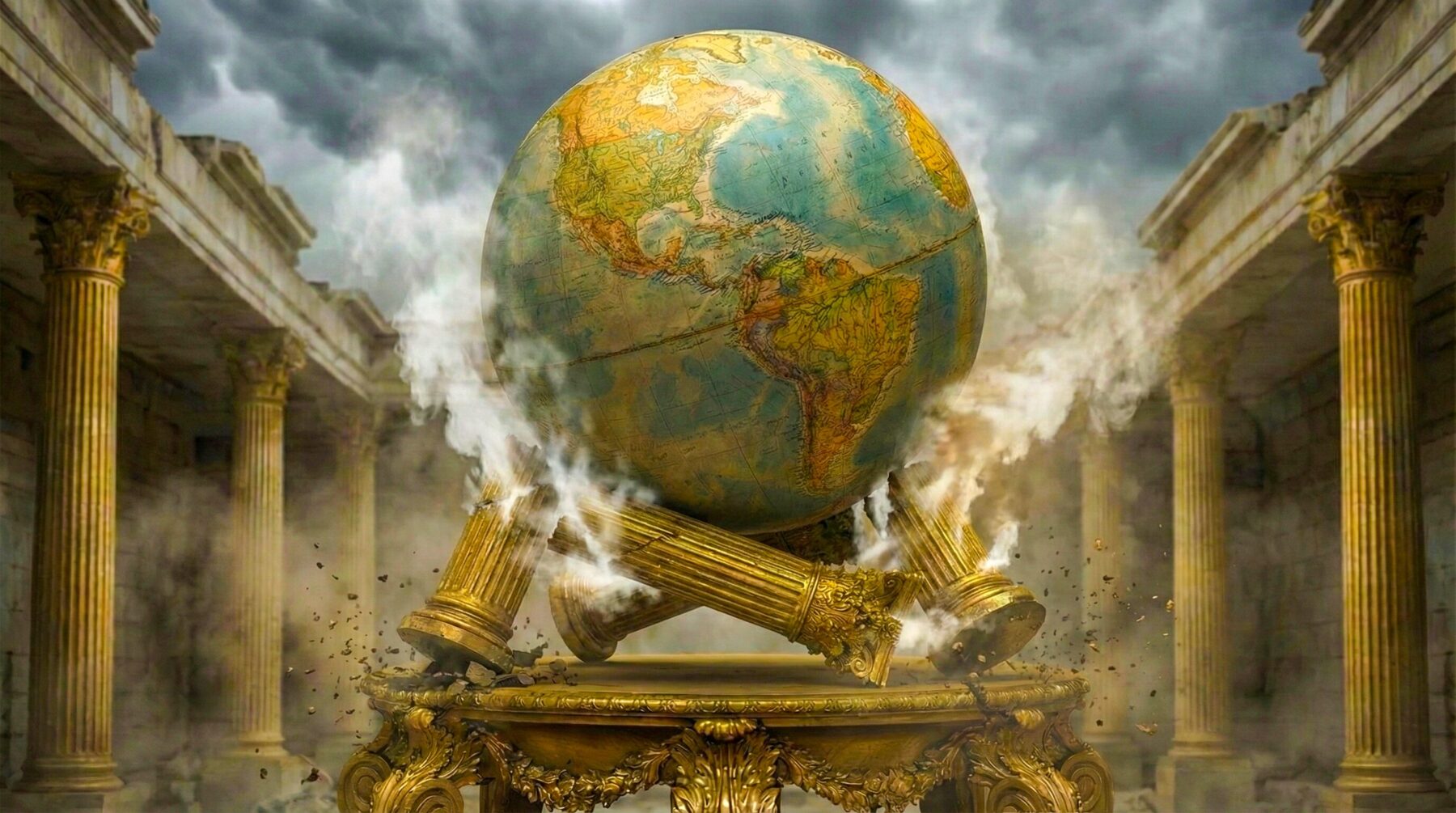
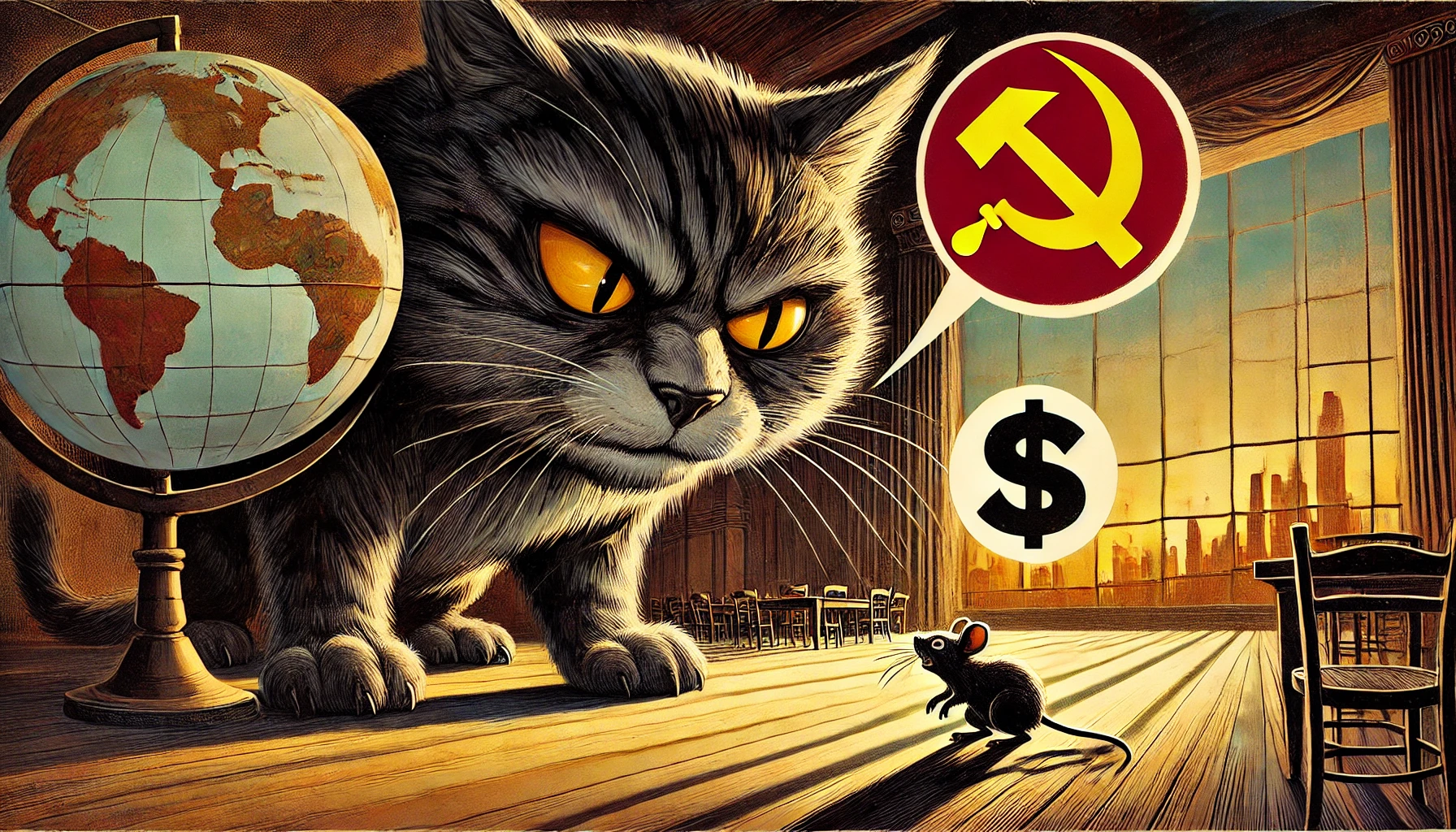
Across the globe, autocrats are waging a war on democracies. The autocrats are winning. Why? How?
Across the globe, autocrats are waging a war on democracies. The autocrats are winning. Why? How?

by Wayne Stelk, PhD November 2025
In Brief
- The Global Decline of Democracy: The essay introduces an essay series about the “Global War on Democracy”, arguing that autocrats are winning. For the first time in 20 years, 91 autocracies outnumber 88 democracies, with 72% of the world’s population now living under autocratic rule. The V-Dem report predicts the U.S. is on the verge of losing its democracy status by the end of 2025.
- The Disparity Paradox: A key paradox is that citizens are voting for illiberal leaders even as global surveys show they strongly support liberal values. For example, majorities favor higher taxes on the wealthy (68%) and believe economies should prioritize well-being over profit. A disparity is found in voters electing leaders who don’t meet their needs, a paradox explored in this essay.
- When Lacking Trust: This paradox is driven by a profound lack of trust in government. Global surveys show only 39% of people trust their government to act in the majority’s interest, making disillusioned voters susceptible to the false promises of “strongman” leaders.
- A Three-Part Perspective: This essay series will investigate these threats to democracy in three parts:
- Part 1, Global War on Democracy, will explore why the public elects these leaders, using an “adaptive life cycle” model.
- Part 2, A Playbook for Autocrats, will present the common strategies (synthesized into eight drivers) that faux-populist leaders use to destroy democratic checks and balances after being elected.
- Part 3, A Path Forward for Democracy, speculates that democracy’s future depends on the “will of the people.” To regain public confidence, liberal leaders must shift their focus to “bread-and-butter” issues that voters prioritize —such as the economy, cost of living, and public safety —and moderate their positions on unpopular cultural issues. Glimmers of hope are seen in new European leaders successfully running on platforms of economic fairness.
Introducing a New Essay Series: The Global War on Democracy
There is an old joke that goes like this: “Just because you’re paranoid doesn’t mean they are not out to get you.”
Liberal leaders of representative democracies are right to feel paranoid because they are a targeted breed. Data from the research firm, Variables of Democracy (V-Dem), tell us why.
For the first time in 20 years, autocracies outnumber democracies globally, with 91 autocracies compared to 88 democracies across 179 countries.
In 2024, 61 countries had national elections, and the voting outcomes only strengthened this global trend. Only 11 of 61 countries became more liberal, with 50 countries trending toward autocracy. In 2024, seven countries were added to the “watchlist” as potential autocratizers, including some in Europe.
The proportion of the global population living in liberal democracies has reached its lowest level in 50 years, with fewer than 12% under liberal regimes, while 72% now live under autocratic rule.
The V-Dem Democracy Report 2025 shows no evidence of this trend reversing. Global democracies are in a persistent trend toward autocratization, declining freedoms, withering human rights protections, and the repression of free speech and independent media.
While regional patterns vary, almost no part of the world is immune to this trend. Recent political shifts—especially in the United States—raise the specter of further breakdowns in established democracies. The V-Dem report predicts that the U.S. is on the verge of losing its status as a democracy. It expects its reclassification to be completed before the end of 2025.
Why are autocratic leaders winning in their destruction of democracy? What is their playbook for success? How can future democracies compete against autocracies?
These are three of the many questions we will explore in my new project, The Global War on Democracy.
A Disparity Paradox: What People Value vs. How They Vote
Citizens who are voting in open elections are supporting illiberal leaders who are hostile to liberal values. And yet, global surveys find widespread popular support for liberal pluralism.
An international nonprofit, Earth4All, conducts research and promotes projects to improve the “well-being and prosperity for all on a stable planet.” It recently conducted a study (N = 22,000 survey respondents) across 22 countries, including 18 G20 countries, on respondents’ wish lists for political reform. A number of these countries have autocratic governments (China, Saudi Arabia) or are on the cusp of autocracy (Indonesia, Kenya, Turkey, South Korea, and Mexico).
Here is a sampling of their findings:
- In 17 G20 countries (China was excluded), 68% of adults favor higher taxes on wealthy individuals to fund significant economic and lifestyle improvements for the public. Only 11% opposed.
- Respondents similarly support higher taxes on businesses and those with higher incomes.
- 71% of those surveyed in 18 G20 countries (China was included) believe that major action to reduce carbon emissions is needed immediately—within the next decade. This belief is strongest in emerging economies, with at least half in every country surveyed in favor.
- 68% believe that economies should prioritize the health and well-being of people and nature instead of focusing mainly on profit and growth.
- 65% think their political system needs significant changes or a complete overhaul, and 67% want the economic system reformed.
- Respondent’s strong support for reallocating tax revenues to green energy, universal healthcare, and worker rights. Universal basic income and citizens’ assemblies also attract substantial support.
- When thinking about climate change and protecting nature, 71% of people across 18 G20 countries believe impactful action is needed immediately – within the next decade – to reduce carbon emissions
While these findings reflect popular support for liberal values, other indicators explain why voters are leaning toward autocracies:
- Of 22,000 respondents from 22 countries, only 39% trust their government to act in the interest of the majority, and just 37% trust their government to make long-term decisions for future benefit.
- 62% are optimistic about their personal future, but only 44% are positive about their country’s future, and 38% about the world. Optimism is higher in emerging economies and lower in Europe, Japan, and South Korea.
From these findings, we gain insights into the disparity paradox. Across 22 countries, citizens support liberal values, but only one-third of voters trust their governments to act on their behalf to enact policies reflecting these values.
Could lack of trust in their current governments be one reason why voters are turning to “strongman” leaders (and they are almost always men)? Are these disillusioned voters susceptible to the false promises of self-serving leaders to champion the people and fight the corrupt elites?
Unfortunately, there are no simple answers to these questions. And that is the reason for this investigation into the why and how of democratic backsliding.
What is the “Liberal Pluralism” That We Are Losing?
President Vladimir Putin claims that the Russian Federation is a democracy. Since the founding of the American and French democracies in the 18th century, the foundational principle, the term “democracy” has been used and abused in countless ways. During the first days of the American Republic, “all men are created equal” referred to European men who owned property. Women, African slaves, Native Americans, and indentured servants did not have the civil rights of the landed gentry. Early American democracy did not support liberal pluralism.
What, then, is a genuine “liberal democracy?” This wall poster in a medical clinic near my hometown offers a good definition of the pluralistic ideals supported by liberal democracies:
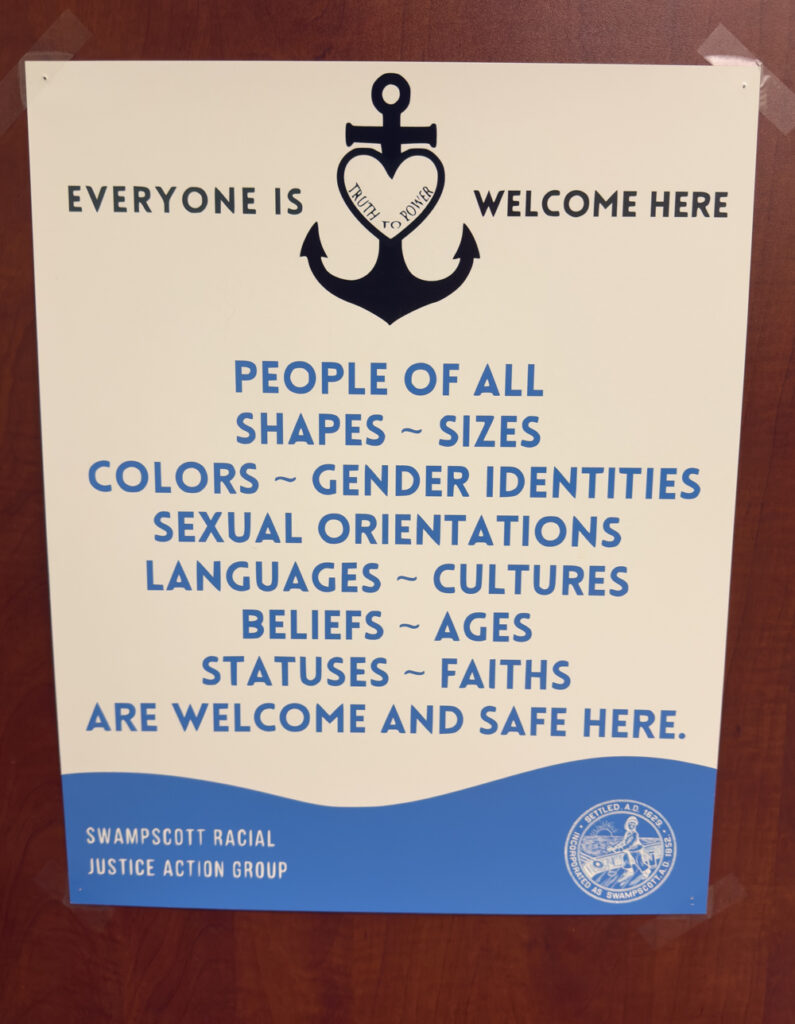
Some may read this list of welcomed identities and say, “Of Course. Doesn’t everyone think like this?” But many would tear this poster down if they could.
In effect, the Trump administration is tearing down this poster within the federal government. By the standards of Trump and his loyalists, this medical clinic is far too “DEI” (promoting diversity, equity, and inclusion). Pluralistic values like these are literally being erased from governmental offices, publications, websites, and national parks.
America’s Vice President, J.D. Vance, offers this example of a conservative possessed by illiberal thinking. Vance recently faced criticism for publicly stating his hope that his wife, Usha Vance, who is Hindu, will eventually convert to Christianity. During a Q&A with the audience, a questioner asked why conservatives have made Christianity a prerequisite for being considered a patriotic American.
Vance responded, “Do I hope eventually that (Usha) is somehow moved by the same thing that I was moved in by church? Yeah, I honestly do wish that. Because I believe in the Christian Gospel, and I hope eventually my wife comes to see it the same way.”
Here we have America’s Vice President publicly stating that Christianity is superior to all other religions, and that all reasonable people (such as his wife) should abandon their “misguided” native beliefs and come to understand the “true and universal doctrine” of the Christian Bible.
Responding to Vance’s wish for his wife’s conversion to Christianity, an Indian, Suhag A. Shukla, posted this on X: “You’ve said lovingly that Usha is your greatest blessing. Why wouldn’t you then appreciate the spiritual heritage that helped lead her to be that blessing in your life? As Hindus, we believe that there are many ways to know the Truth…”
Like Ms. Shukla, others used social media platforms to push back on Vance’s Christian-supremacy logic. Vance, in turn, branded this push-back as “anti-Christian bigotry.”
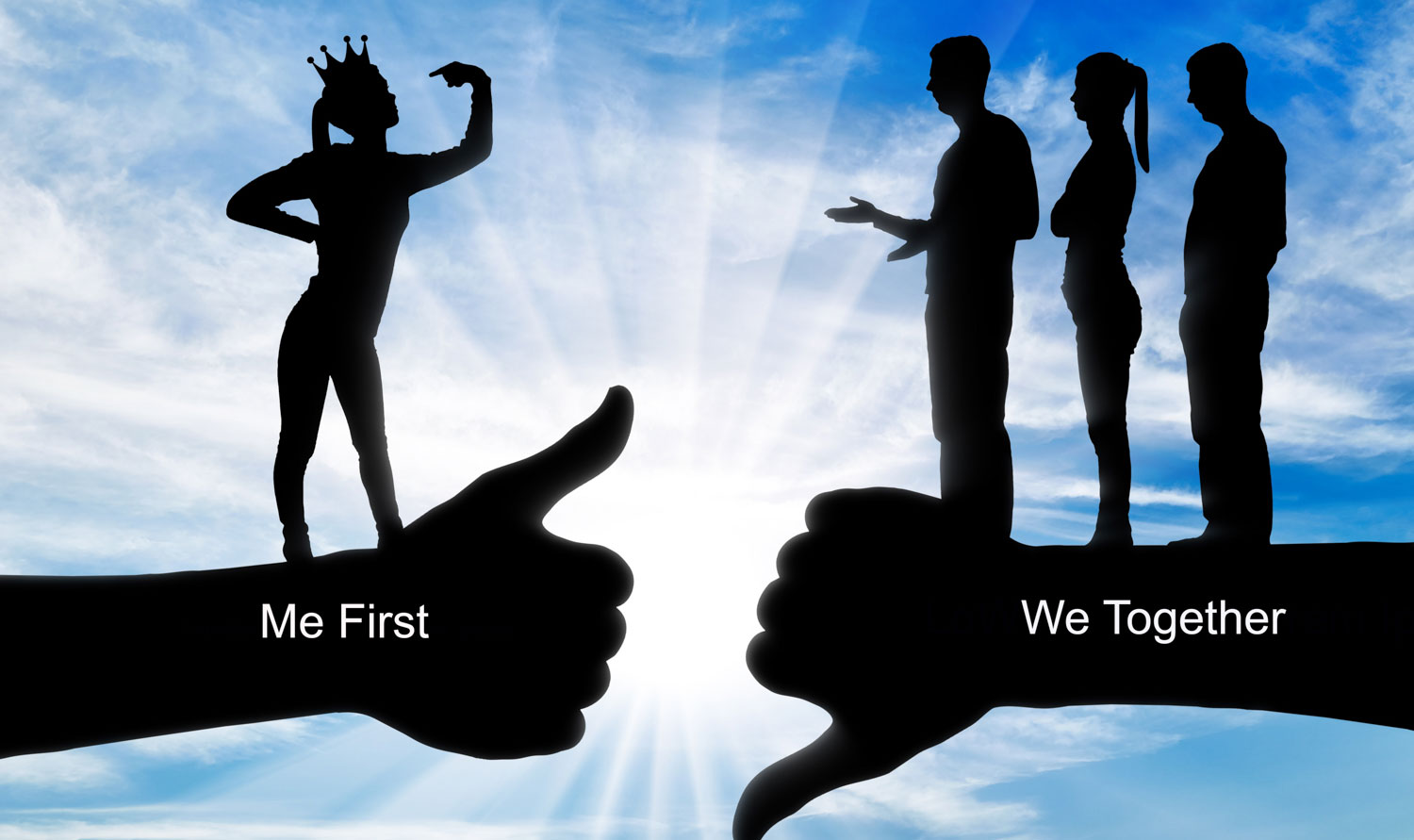
In this dust-up with Vance and religions that dare to be non-Christian, we have a clear example of a cognitive style that is vertical vs. horizontal, and rigid vs. flexible.
- Vance’s religious beliefs are vertical in that, in his worldview, religions can be placed on a hierarchy of superior and inferior. By Vance’s values, Christianity is at the top of the hierarchy, making it superior. All other religions are lower on the hierarchy, making them inferior. Vance’s one path is the “right path.”
- Ms. Shukla’s belief that there are many paths to universal truths is an example of horizontal thinking – there are many paths to universal truths.
- Vance’s response to this corrective feedback was to label it as “anti-Christian bigotry.” Vance’s inability to consider the merits of corrective feedback is an example of “cognitive rigidity.” It is a trait of people who are unable to consider worldviews other than their own. Underlying this rigidity is a fragile personal identity that equates change with failure.
We humans are complex creatures whose worldviews are influenced by values that are personally developed, socially transmitted, and culturally embedded in our brains. Complexity arises from how we blend these value domains (self, peer groups, culture) into political ideologies, supporting polar opposites: rigid autocratic doctrines or open societies that would fight those who would tear down the poster in my doctor’s office.
Project Overview – The Global Way on Democracy: A Playbook for Autocrats
I invite you to follow me on a multidimensional journey to learn why liberal democracies are slipping away, only to be replaced by self-serving, authoritarian autocracies.
Over the next few months, I will publish a series of quick and easy-to-read essays that pursue three core questions:
- Why is the voting public in so many countries electing authoritarian leaders who promise (falsely) to slay the corrupt elites and improve their quality of life?
- What strategies are these authoritarian leaders so successfully using to win popular support while destroying the infrastructure of their nations?
- How do the world’s democracies, which are fragile and difficult to manage, resurrect themselves to become effective executors of their publics’ diverse beliefs, desires, and needs?
These separate but interrelated questions will be explored in three parts.
Part 1: The Global War on Democracy
The war on democracy is not an event with a well-marked beginning, middle, and end. This war is a process that evolves and takes different formats depending on the country where autocracy is rising.
The alternating rise and fall of democracy and autocracy can be seen as a continuous cycle spanning years, decades, or even centuries. Under the leadership of Mikhail Gorbachev and, to a lesser extent, Boris Yeltsin, post-Soviet Russia experienced barely 15 years of democratic reform under the banners of
perestroika and glasnost. The American experiment with democracy is nearing its 250th anniversary.
Because governments and social institutions are human creations, we can think of them as living systems with alternating cycles of growth and decline that resemble those of human life. This cycle is adaptive in that our lives are a continuous process of adjusting to environmental circumstances—social and physical.
This adaptive process of life is represented in this chart:
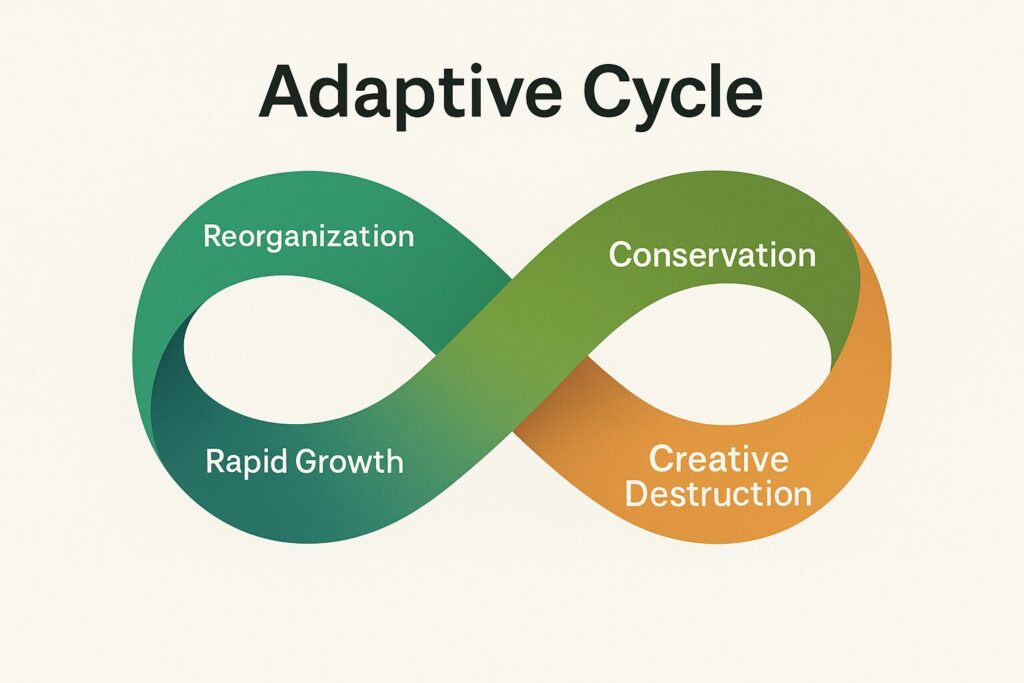
There is no beginning or end in this cycle because it represents a continuous flow between stability and change. New growth begins from the disintegration of old growth. Progress must be conserved; otherwise, it becomes chaotic. But stability weakens if it does not adapt to changing environments. The stability to which we cling thus gives way to disruptive reorganization, leading to renewed growth.
In Part 1, we will see how this adaptive life cycle applies to the evolution of values and beliefs in individuals, to the formation of social groups that form political alliances—sometimes to extremes —and to governments themselves, with their ever-evolving, transforming political ideologies.
Think of Part 1 as a roller-coaster ride that traverses many layers of human existence – personal, social, cultural, and social institutions. These intertwined layers shape the governments that, in turn, shape the quality of our lives. Our roller-coaster journey will dip into the dark corners of political extremism. It will also rise to higher levels, giving us glimpses of social orders that value the pluralities of ethnicity, skin color, beliefs, and cultures.
The roller-coaster metaphor is apt because the descent into extreme polarities requires far less energy than the rise to social equities. Liberal democracy requires greater public effort than does doctrinaire autocracy. We will also see that quality of life is less satisfying at the lower dips of autocracy than at the higher (but more effortful) elevations of democracy.
For example, we will review one of several studies showing that, after 15 years of autocratic rule in 51 countries, GDP per capita was 10 percent lower compared to a plausible nonpopulist government. Economic disintegration, decreasing macroeconomic stability, and the erosion of institutions typically go hand in hand with autocratic populist rule.
Part 2: A Playbook for Autocrats
If Part 1 is a roller-coaster ride through the layers of liberal and illiberal worldviews, think of Part 2 as taking real-time snapshots of autocratic carnage.
Authoritarian leaders who dream of total control most often gain power by presenting themselves as populists who will save citizens from the evils of the ruling elites who have robbed them of their dignity and livelihoods. Once elected, these faux populists destroy the pillars of their nation’s democracy. Liberal democratic values are the antithesis of their dictatorial rule, which allows them to rape their country’s resources and redistribute the national bounty to themselves and their wealthy loyalists.
Toward this end, autocrats use a similar playbook to destroy accountability checks and balances and to establish themselves as the voice and muscle of their country. In Part 2, I will use independent media sources to “freeze” these activities to document the dire effects on their countries.
Note that I did not invent this autocracy playbook. A number of scholars, journalists, and think tanks have published autocracy playbooks listing a wide variety of takeover strategies. My task was to identify and group this myriad of methods into a comprehensive collection of major autocracy drivers and secondary strategies.
In this synthesis of many playbooks, I have identified eight major drivers of autocratic conversions. Here is a chart identifying these eight autocracy drivers with a sampling of related strategies:
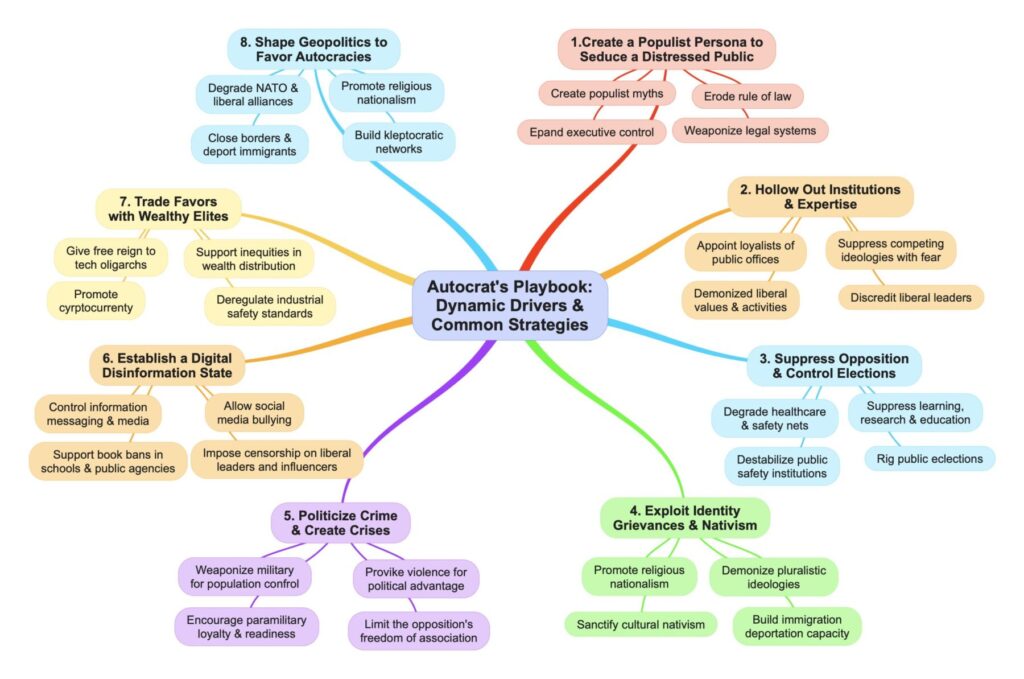
In Part 2, for each driver and related strategies, I will draw on press reports and other sources to document the real-time actions that destroy democracies and harm the public by creating uncertainty, fear, a loss of social benefits, and a greatly diminished quality of life.
Part 3: The Future of Democracy – Optimism or Pessimism?
When a cornucopia of populist promises seduces the public into supporting them, and when an authoritarian regime fails to deliver on those promises, what are the chances of a pluralistic democracy rising from the ashes of painful delusions?
The short answer is that the viability of an autocracy depends on the will of the people to recapture the power of their government. This short answer is not a simple solution. The greater the autocrats’ destruction of democratic checks and balances, and the greater the control autocrats exercise over media platforms, the greater the challenge of restoring democracies.
As noted, the global trend is toward democratic backsliding and autocratic wins. Again, we encounter the paradox of people favoring a liberal agenda while electing autocrats to implement it.
A recent American survey was conducted by Earth4All in August 2024, before Donald Trump was re-elected president. It took a deep dive into this disparity paradox. The Earth4All study found that most Americans simultaneously endorse democracy while not entirely rejecting authoritarian, theocratic, or plutocratic alternatives.
It is this public ambivalence (the paradox) that makes democracy vulnerable.
- 41% of Americans think “having a strong leader who does not have to bother with parliament or elections” is a good system—with higher support among men, higher earners, and younger people.
- Support for theocracy and army rule is also notable, at 34% and 33% respectively.
- Only 31% view a plutocracy (rule by the wealthy) as a positive system, but support for plutocratic leaders (the wealthy elites) is growing among men and younger people (specifically Gen-Z).
- Similar to the global survey, only 39% of Americans trust their government to act in the majority’s interest, and just over a third trust it to act in the long-term interest.
If liberal leaders have any hope of rescuing broken governments from predatory autocrats, the democracies of tomorrow will have to look very different from those of today. Future democracies will have to regain public confidence by generating favored results.
In a recent soul-searching exercise by prominent American Democrats, liberal candidates for office must make a conscious decision to prioritize the most pressing concerns of the broader electorate—shrinking the gap between a party’s agenda and voter priorities—and orient messaging, candidates, and strategies accordingly. They even suggest taking a page from prior winning campaigns and successful contemporary candidates, regardless of party ideology.
These reform-minded Democrats offer two specific recommendations:
- Focus more on the issues voters do not think we prioritize enough (the economy, the cost of living, health care, border security, public safety), and focus less on the issues voters think we prioritize too highly (climate change, democracy, abortion, and identity and cultural issues), and
- Moderate party positions on issues where the Democratic party agenda is unpopular, including immigration, public safety, energy production, and some identity and cultural issues.
Glimmers of hope for the restoration of democracies can be found. Recent reports from the U.K and the Netherlands show liberal wins in elections (the Netherlands) and popularity polling (the UK).
In the UK polling, a charismatic Green Party leader, Zack Polanski, is gaining traction with UK voters by running on a platform of economic fairness, lower cost of living, and affordable housing. He is seen as a leader on bread-and-butter issues facing ordinary people, including his support for a wealth tax on the UK’s richest individuals.
In the Netherlands, Dutch voters favored the policy platform of Rob Jetten, another young leader who is charismatic, gay, and pro-European. He similarly supports bread-and-butter issues, such as affordable housing, green energy, and national unity.
Notably, both of these rising liberal stars are charismatic, white, young, and male. We must then ask, are voters attracted to their policies, their personalities, or a combination of both? Under what conditions do these same dynamics favor illiberal states?
Ultimately, the choice of political leadership is akin to building a model of a government on a three-legged stool. One leg represents a volatile environment. The second represents a public who is stressed by the environment and feels uncertainty, despair, and maybe anger. The third leg represents emergent leaders who seek opportunities for their own advancement. Vertical-thinking leaders inflame public grievances, whereas horizontal-thinking leaders seek to bring people together for healing and problem-solving.
The loss of any one leg of this platform (an environmental disaster, a polarized public, and/or failure of leadership) will cause the model to collapse. This outcome can crush any government, such as the Soviet Union in the 1980s, and more recently in Haiti, Sudan, Somalia, and too many other countries listed in the Fragile State Index.
No one can predict the future of democracies rising from the ashes of failed autocracies. However, by taking snapshots of the autocracy playbook and its adverse effects on societies, perhaps we can find ways to balance our nations on a three-legged stool when buffered by turbulent winds.
Estimated reading time: 17 minutes