
The Four Toxic Pillars of Trump’s Foreign Policy
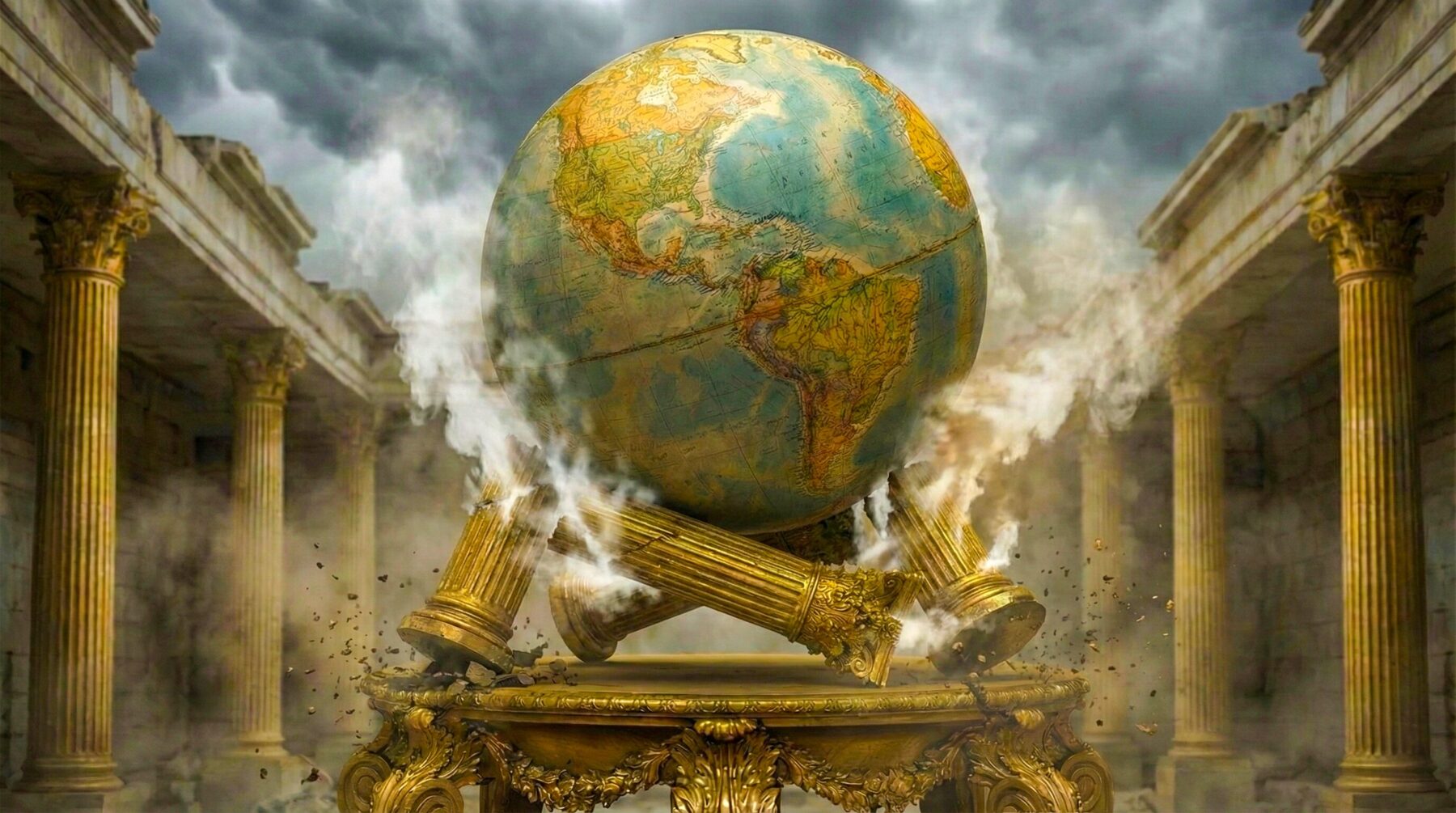
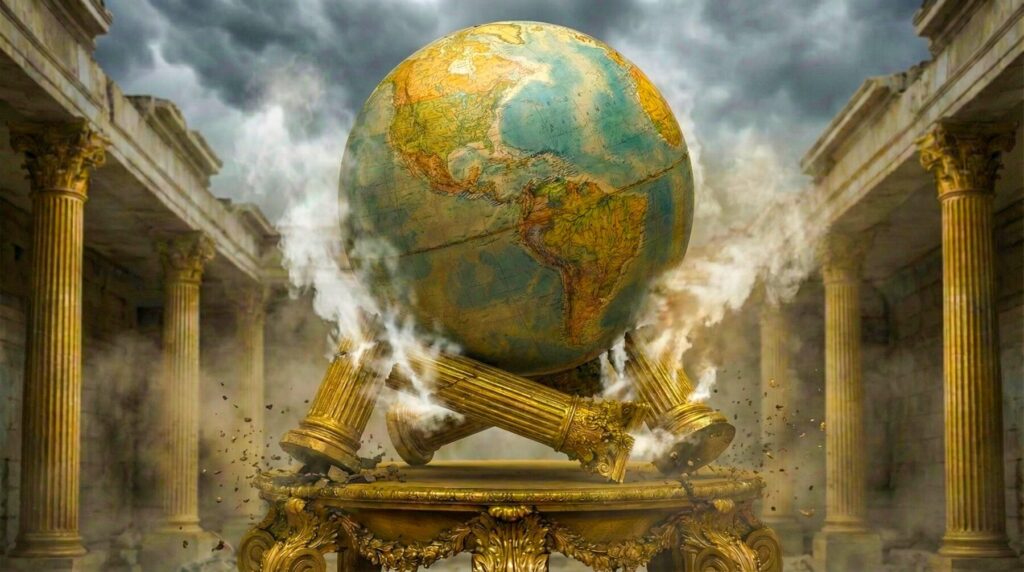
Donald Trump’s foreign policy is built upon toxic pillars of greed, coercion, nativism, and incompetence.
In Brief: The Four Pillars of the Donroe Doctrine
- Overview of the “Donroe Doctrine”: With the U.S. Delta Force’s capture of Venezuela’s Nicolás Maduro on January 3, 2026, Trump’s foreign policy “Donroe Doctrine” becomes real—an offensive inversion of the Monroe Doctrine aimed at hemispheric dominance of the Americas.
- Policy Deception and False Flags: Trump’s true design for his Donroe Doctrine is cloaked in moral deception. His “war on drugs” in Venezuela betrays his indifference to substance abuse disorders. His administration has slashed $345 million from addiction research, proposed cutting $26 billion more from substance abuse prevention and care, frozen UN-backed drug-interdiction programs, and pardoned convicted drug traffickers, including cartel-connected figures.
- The Psychological Roots: Trump’s true motivations for world domination are fueled by what experts describe as “power addiction” and “Dark Triad” traits—narcissism, Machiavellianism, and psychopathy. Trump’s need for dominance requires the submission of others and rejects collaborative leadership.
- Pillar I: Greed: Trump has doubled his net worth during his second term as president while pursuing foreign deals in the UAE, India, and Vietnam. His wealthy associates are positioned to profit from investments in Greenland and Ukraine. The Donroe Doctrine is a portfolio of deals in which countries are positioned on cost–benefit ledgers. Greed is institutionalized through self-dealing, crypto schemes, and resource grabs.
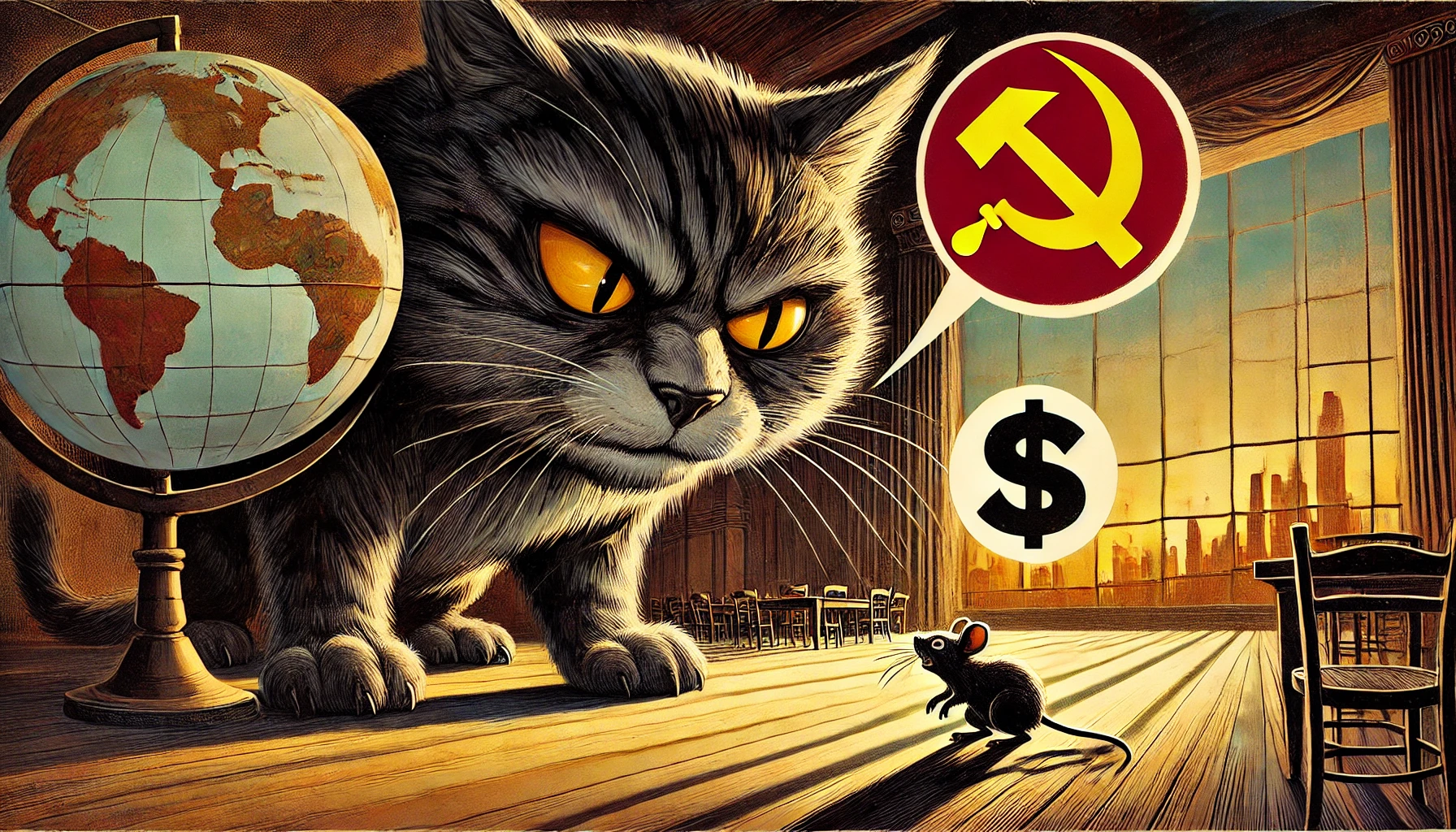
- Pillar II: Coercion: Trump’s foreign policy operates on a “plata o plomo” (silver or lead) transactional basis. Foreign leaders face a binary choice: comply and receive transactional favors (as Colombia’s Petro did), or resist and face military removal (as Venezuela’s Maduro did). This nations-as-assets dealmaking style applies mob-boss logic to statecraft.
- Pillar III: Nativism: The Donroe Doctrine is underpinned by a “Heritage American” ideology that defines “true” citizenship not by legal status but by white European identity. As Trump’s chief advisor, Stephen Miller’s “America for Americans only” ideology shapes both domestic and foreign policy.
- Pillar IV: Incompetence: Trump has replaced “spheres of alliances” with “spheres of dominance.” The failures of this approach are already evident. The administration has alienated Canada to the point where it seeks a strategic partnership with China. Trump’s war on drugs, which relies on outdated “kingpin” strategies, is ineffective against decentralized drug cartels. Quick returns from seizing control of Venezuelan oil are viewed as illusory. And Trump’s desire to control Greenland could weaken the NATO alliance, earning rapturous applause from Russia’s Vladimir Putin and China’s Xi Jinping.
- The Real Truth: The Trump administration’s “gunboat capitalism” and spectacle-driven dominance do not demonstrate strength. The Donroe Doctrine is infected with a brittle, dangerous pathology that raises global catastrophic risk—unless and until it can be washed away by a tsunami of truth and humanity.
Introduction
Global headlines on January 3, 2026, reported the unprecedented: a U.S. Delta Force raid captured Venezuelan President Nicolás Maduro and First Lady Cilia Flores, delivering them to New York to face narco-terrorism charges. Ordered by President Donald Trump, the assault on a sovereign state effectively codified the “Donroe Doctrine.”
The Donroe Doctrine is an aggressive inversion of the 19th-century Monroe Doctrine. While the original policy was a defensive shield—warning European powers against interfering in the Western Hemisphere—this new iteration is an offensive weapon.
The “Donroe” approach (a portmanteau of Donald and Monroe) is less a written policy than a brute-force practice. If the Monroe Doctrine was designed to protect the Americas from foreign colonization, Trump’s Donroe Doctrine is designed to subject the Americas to absolute U.S. dominance and control of resources.
The Promise of the Donroe Doctrine
To justify geopolitical aggression, the Trump administration has cloaked the Donroe Doctrine in elaborate vestments styled to please the most devoted MAGA acolyte. The doctrine is one of imperial royalty: unrivaled strength backed by a military force capable of protecting Americans from “hostile foreigners” and their “rot” that is infecting the Americas.
Trump’s doctrine promises to save the Western Hemisphere not just from evil outsiders, but from itself. The public face of this doctrine is nativist morality: virtuous Americans fighting internal sins and external weakness.
Do not be fooled by the valorous pageantry of this MAGA-inspired foreign policy. The populist promise of the Donroe Doctrine is a trickery built on a foundation of false narratives, greed, coercion, nativism, and incompetence.
Donroe’s Foundation of False Narratives
The Trump administration has created a false-flag narrative to justify its invasion of Venezuela. This narrative claims that the U.S. is protecting its citizens by portraying President Nicolás Maduro as the head of an elaborate drug cartel that is flooding the United States with cocaine and fentanyl. This narrative is laughable when exposed to counterfactual evidence.
Consider this: If the U.S. is serious about protecting Americans from the illicit drug trade, why did the Trump administration dismantle federal funding for the public health treatment of drug abuse?
A genuine war on drugs is a battle on two fronts: supply and demand. Supply-side strategies involve attacking illicit drug suppliers. Demand-side strategies reduce the need for drugs by treating people with substance use disorders. Trump’s so-called war on drugs fails on both fronts.
On the supply side, Trump’s global foreign aid freeze has halted a United Nations-backed container-control program at Mexico’s Port of Manzanillo and blocked its planned expansion to two other major seaports, undermining a key effort to interdict fentanyl precursor chemicals and other drug-related contraband. Analysts say freezing drug-interdiction programs like these signals a U.S. shift away from cooperative security assistance toward a more confrontational posture, which is deemed less effective.
On the demand side, imagine this scenario: By some miracle, all people who are dependent on illicit drugs suddenly stop using those drugs and never return. In this scenario, the drug cartels are defeated immediately. No demand, no need for supply.
Contrary to reducing demand, the Trump administration is increasing the demand for drugs. It is doing so by eliminating almost all funding for domestic drug treatment and by diverting resources from detecting drug cartel activity. This policy failure is evidenced by the administration and Congress slashing at least $345 million from addiction and overdose research. Going forward, the administration wants Congress to eliminate $26 billion more from overdose prevention and addiction care.
There can be no doubt that Trump’s “war on drugs” is a false flag. Consider Trump’s pardon of former Honduran President Juan Orlando Hernández, who was serving a 45-year U.S. prison sentence for conspiring with cartels to traffic 400 tons of cocaine and for accepting millions in bribes. And during Trump’s two terms as president, he has granted clemency to about 100 people convicted of drug-related offenses, including high-profile drug cartel bosses such as Silk Road founder Ross Ulbricht, Chicago gang leader Larry Hoover, and Baltimore drug boss Garnett Gilbert Smith.
The Bio-Psychology of the Need for Power
Trump and his loyalist advisors conjure up many false narratives to portray his foreign policy as benefiting the world at large. When a small group of people with the political, economic, and military muscle to alter international relations, it is fair to say that these individuals have an excessive need for power.
If we want an in-depth understanding of Donald Trump’s foreign policy, we should focus not only on the ideology but also on the bio-psychology of the people who have created it. What are the “wet (biological) roots” of a small group of political leaders with great power who have an absolute and pathological need for power and control?
Six political scientists, surveyed by Thomas Edsall for the New York Times, converge on a clinical-sounding diagnosis of Donald Trump as exhibiting compulsive, addiction-like behavior driven by a power-seeking impulse. These are the highlights of their analysis:
1. The Neurobiological Mechanism: Several experts argue that the drive for power functions biologically like a substance addiction.
- The Dopamine Loop: Power is described as “intoxicating,” activating the brain’s dopamine reward system in the same way drugs do.
- Escalating Tolerance: Because the brain adapts to the “dopamine high”, the addicted individual requires ever-increasing “doses” of social dominance to achieve the same reward, leading to an “unquenchable appetite” for control.
2. Psychological Drivers and the “Dark Triad”: This addiction grows in the biological context of specific, overlapping personality traits that create a compulsive need for superiority.
- Dark Triad Personality Traits: Trump is cited as an example of a well-known psychological profile, consisting of Narcissism (craving greatness), Machiavellianism (viewing politics as manipulation), and Psychopathy (lack of empathy).
- Inner Regulation: For some, this power addiction is a defense mechanism used to regulate unmanageable internal states, such as profound emptiness, fear, or paranoia.
3. Behavioral Consequences: The addiction to power can manifest in specific, destructive leadership behaviors.
- Compulsive Control: The individual exercises power in inappropriate contexts and cannot stop seeking to increase control, often at the expense of social cohesion.
- Aggression & Dehumanization: Instead of collaborative leadership, the addiction leads to resource hoarding, dehumanization of others, and vengefulness.
- Inability to Concede: The dopamine-linked craving for status makes the loss of power psychologically intolerable, explaining the refusal to accept defeat.
If Dark Triad personality traits shape Donald Trump’s need for power and control, Stephen Miller is Trump’s operational master. Sometimes referred to as Trump’s “prime minister,” Miller is one of Trump’s closest and most influential advisers. His view that “might makes right” aligns with Trump’s delusions of grandeur.
In this context, Miller paints a portrait of himself in his own words:
We live in a world in which you can talk all you want about international niceties and everything else, but we live in a world…that is governed by strength, that is governed by force, that is governed by power…These are the iron laws of the world since the beginning of time.
For several key officials advising Donald Trump, power, control, and domination are not enough. In their binary world of good and evil, U.S. government employees are evil and must be treated as such. The cruelty of this binary worldview is demonstrated by Russell Vought, Trump’s Director of the Office of Management and Budget (OMB) and the primary author of Trump’s playbook, Project 2025.
Here is Russell Vought expressing his most cruel insincerity. Speaking about civil servants working at the Environmental Protection Agency (EPA), Vought said this:
We want the bureaucrats to be traumatically affected. When they wake up in the morning, we want them to not want to go to work because they are increasingly viewed as the villains…We want to put them in trauma.
The ideological pillars on which Donald Trump’s foreign policy is built are brittle because of the complex interaction of bio-psychological, social, and political factors.
These pillars of Trump’s foreign policy are rooted in self-interest rather than cooperation to advance mutual interests. I will detail four toxic pillars that prop up Trump’s foreign policy: greed, coercion, nativism, and incompetence.
Pillar I: Greed
For nearly half a century, American presidents have separated themselves from their business interests through blind trusts or divestment. In the modern era, Donald Trump stands alone in retaining full ownership of his business empire while serving as president.
Since his second term began in January 2025, Trump’s net worth has roughly doubled, rising from about $3.93 billion in 2024 to $7.37 billion in 2025, driven mainly by crypto ventures, his media/tech company, and new licensing deals.
Trump and the Trump Organization have pursued or expanded a series of foreign deals that either generate direct income (fees, licensing, crypto proceeds) or enhance the value of Trump‑branded assets, with several prominent examples tied to his second term.
- The Trump Organization has been actively pursuing new Trump-brand developments in the UAE, India, and Vietnam, taking advantage of a permissive arrangement that bars only deals “directly” with foreign governments while allowing projects with government‑linked developers.
- A New York Times investigation detailed a roughly $2 billion digital‑currency deal in which a UAE government‑backed firm would transact using a token issued by World Liberty Financial, a crypto venture owned by the Trump and Steve Witkoff families, generating large profits for both families while Witkoff is simultaneously pushing for U.S. approval of advanced A.I. chip sales to the UAE.
- It is worth noting that Steve Witkoff and Trump are close business associates. I have previously written about how Witkoff is one of Trump’s lead negotiators for a peace treaty between Russia and Ukraine. Witkoff’s proposed deal is primarily about expanding business opportunities for the U.S. in both Russia and Ukraine.
Given Trump’s track record of using the office of the presidency to leverage business deals that profit Trump, his family, and his wealthy associates, it should come as no surprise that Trump’s removal of Nicolás Maduro was a pretext for gaining control of Venezuela’s natural assets, the primary one of which is its oil reserves. But is oil Trump’s only objective for that country? Is Venezuela just one piece of a larger strategy?
Writing for the Universidad de Navarra in Pamplona, Spain, political scientist Alberto Ferreres Fernández gives us this perspective:
Trump’s foreign policy resembles a portfolio in which every country is a case study in a cost-benefit analysis…Long-term strategic interests are weighed against short-term financial returns and, more often than not, the balance sheet dictates the outcome. The signal is unmistakable: America is no longer the global sheriff, nor the patron of liberal democracy. Instead, under Trump, it has become a leaner and tougher enterprise that expects loyalty, results and preferably a profit margin.
While Trump may not personally profit from the business deals the U.S. makes with foreign nations, you can assume that the profits from those deals will not flow to the American public. It is the business elites Trump favors who will benefit.
In one of the first transactions involving the U.S. seizure of Venezuelan oil, the administration is selling a $250 million batch to Vitol, the world’s largest independent oil trader. Could there be an unethical coincidence that a senior Vitol trader involved in securing the contract has poured millions into political action committees backing Trump’s re-election and met with Trump at the White House just days before the agreement was finalized?
Another example of Trump’s support for the billionaire class is his 60-year friendship with Ronald Lauder, heir to the global cosmetics brand Estée Lauder. In 2018, during Trump’s first term as president, Lauder pitched Trump the idea of establishing a “strategic partnership” with Greenland. Lauder framed Greenland as having rare‑earth elements, AI‑critical minerals, and new Arctic shipping routes.
During Trump’s second administration, the idea of gaining control over Greenland’s assets and North Atlantic shipping routes has grown to the point that Trump is threatening a military takeover. While Trump blusters and rattles swords, Ronald Lauder is quietly investing in Greenlandic companies, including “luxury” spring water exports and a planned hydroelectric project tied to an aluminum smelter. He also has Ukraine in his investment crosshairs, as he has quietly joined a consortium planning to develop a large Ukrainian lithium deposit.
Pillar II: Coersion (¿plata o plomo?)
Donald Trump has what could be considered a pathological need to impose his will on others. He demands loyalty from his subordinates and offers them nothing in return. For those who disagree with Trump on a transaction, his first tool of coercion has been to file a lawsuit. Between 1973 and 2016, prior to his presidency, Trump or his organization filed over 4,000 lawsuits.
Today, as president, Trump has expanded his options for coercion by taking control of the U.S. military. His geopolitical expansionism now uses a negotiating tactic made popular by Pablo Escobar, former head of the Medellín drug cartel. When Escobar wanted to acquire an asset and the owner resisted, he would offer plata (silver) or plomo (lead).
Under Trump’s second-term ‘transactional’ approach, foreign policy has increasingly been framed as dealmaking and cost–benefit leverage rather than rules-based reciprocity. And when reciprocity fails, there is always coercion – “soft or hard.”
President Nicolás Maduro learned about the “hard” option when he resisted Trump’s demand to leave Venezuela. Maduro’s resistance to Trump’s demand led to his capture and incarceration in a New York City jail. Trump’s decisive military actions against Maduro sent a message to other heads of state deemed adversarial by the Trump administration: plata o plomo—a gold coin or a lead bullet?
Gustavo Petro, president of neighboring Colombia, appears to have gotten the message. Long considered the epicenter of the cocaine trade in Latin America, Petro has denied links to the drug cartels in his country. While he denounced Trump’s military action against Venezuela, Petro has responded to Trump’s demand that he vacate his presidency. Petro is avoiding the lead bullet in favor of a gold coin by accepting Trump’s invitation to meet in Washington, D.C., in the coming weeks.
As noted, Trump wants to acquire Greenland for U.S. national security (another false flag?), but more likely for its strategic natural resources. And how is Trump pitching this unpopular idea to Greenlanders:
“I would like to make a deal, you know, the easy way, but if we don’t do it the easy way, we’re going to do it the hard way.”
At this writing, European troops are being sent to Greenland as a countermeasure to the plomo option. In response, Trump is imposing a 10-25% tariff on Denmark and seven other European countries for their resistance to Trump’s purchase of Greenland.
Clearly, Donald Trump is attempting to impose his will on the entire world with the coercive mentality and muscle of a mob boss.
Pillar III: Nativism
At its most basic, liberal democracy generally emphasizes civic inclusion and institutional protection of plural identities. Autocracies emphasize a dominant national identity and use coercion and control to restrict political and cultural pluralism.
Nativism is a largely American notion that regards the descendants of America’s original (white) European settlers as the “true” founders of the United States. From the nativist perspective, true Americans are not defined by their legal status but by their European identity.
In some extremist ideologies, a “Heritage American” identity confers a superior claim to being a native of the country. Never mind that indigenous Native Americans populated North America for thousands of years. Having European lineage makes you a “preferred American.”
This is what Stephen Miller, one of Trump’s most senior advisors, meant when he appeared at a rally for Trump in 2024 and proclaimed:
“America is for Americans and Americans only!”
By this proclamation, Miller defines “Americans only” as an identity-based membership that excludes not just immigrants and racial minorities, but also anyone who defends human rights or rejects state violence against these targeted “enemies” of America. Liberals who defend the principles of diversity, equity, and inclusion (DEI) are not true Americans.
“America for Americans only” is a cornerstone of MAGA’s domestic extremism. Thanks to ideologues like Stephen Miller and others, this nativism is woven into the fabric of Trump’s formalized foreign policy statement, the National Security Strategy 2025 (NSS 2025).
The NSS 2025 is a 33‑page strategy arguing that Europe is in economic decline and faces multiple existential problems. These are Trump’s criticisms of the European Union (EU), briefly summarized:
- EU overreach: (centralized EU institutions that promote liberal values),
- Migration transforming the continent: (immigrants are diluting national heritages)
- Censorship of speech: (free European news outlets allow debate of right-wing ideologies)
- Suppression of opposition: (free and fair elections put right-wing candidates at risk of not winning), and
- Loss of national identities: (the dilution of national heritage due to immigration).
Overall, the NSS 2025 highlights far‑right and nationalist parties, including Germany’s AfD, with which Trump officials have cultivated ties, as grounds for “great optimism” about Europe’s political direction toward right-wing autocracies (such as Hungary).
Pillar IV: Incompetence
Donald Trump’s foreign policy is built on competitive, adversarial, and extractive relations between nations. His administration shows no concern for the integrity and welfare of people living in other nations. If an international transaction is good for America’s business elites but bad for a nation’s citizens and its environment, so be it.
This policy platform is lethal because its framework is a power hierarchy that judges all relations as win-or-lose. A geopolitical “sphere of influence” means “sphere of dominance and control.” Those at the top of the power ladder cannot tolerate dissent from those lower down because the top cannot admit to mistakes or failure. Their personal identities are built on a myth of their infallible strength.
This is the “danger everywhere” mindset fueling Donald Trump’s proposal for a space-based “Golden Dome” missile-defense system—estimated at over $3 trillion, which experts in missile defense are calling the “Golden Sieve.”
Trump’s desire to create a “sphere of dominance and control” over America is dangerous for many reasons, including that his policies lack strategic coherence. In other words, the foreign policy crafted by Trump and his advisors is incompetent. Consider these examples.
Eliminating the Drug Cartels
Suppose we take Trump’s war-on-drugs narrative at face value. His strategy of taking out an elected or cartel “kingpin” is outdated. In today’s world, modern cartels are transnational political actors embedded in global illicit supply chains, not localized enemies that can be defeated by decapitating leaders or bombing territorial hubs. Because these networks stretch from Latin America through Europe, the Middle East, and China, they adapt to pressure by shifting routes and production rather than disappearing. It is likely that Maduro’s capture will have no effect on the drug trade in Latin America.
Venezuela
Trump’s grand plan to gain control of its vast oil reserves is ill-conceived. Venezuela ranks at the bottom of global oil-investment attractiveness due to corruption, weak legal protections, and past expropriations of firms such as Exxon and ConocoPhillips. Restoring Venezuelan production to past peaks would take at least a decade and cost on the order of $100–200 billion, making Trump’s promise of quick gains illusory.
Greenland
The administration argues that acquiring Greenland—by purchase or force—is vital to counter Russia and China in the Arctic. But Trump has hollowed out the Pentagon office responsible for coordinating Arctic defense strategy, cutting staff until the office effectively shut down.
Greenland’s rare earth deposits are strategically important to the U.S., but they are economically and technically very difficult to develop at scale before the 2030s, mainly due to processing bottlenecks, Arctic infrastructure costs, and social‑political constraints.
Canada and the Stupidity of Acquisition vs. Alliance
Trump’s “sphere of dominance and control” mindset has driven Canada into the welcoming arms of China. In recent days, Canadian Prime Minister Mark Carney and Chinese President Xi Jinping have announced a new “strategic” Canada–China partnership to repair nearly a decade of strained relations. Through this partnership, Canada aims to double its non-US trade over the next decade, noting that the global economic environment has “fundamentally changed” and that Canada must diversify its partners.
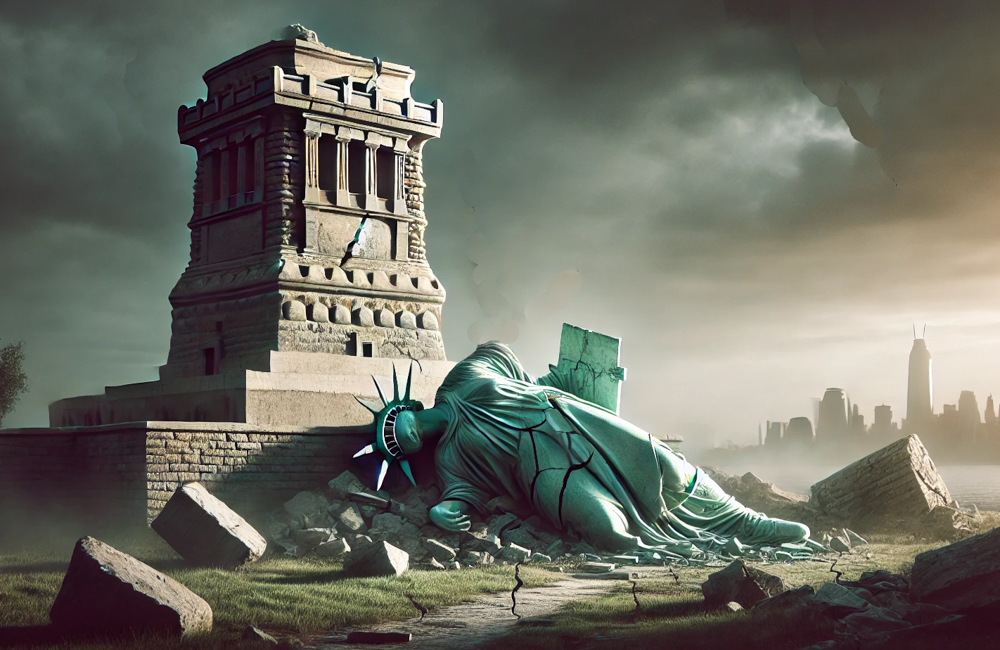
These few examples are a mere sampling of the many incompetencies that corrode the Donroe Doctrine as a foreign policy framework. Trump’s mindset promoting spheres of dominance and control is not new, but in a world armed with nuclear bombs and digital trigger fingers, this mindset is more dangerous than ever in history.
The Truth Revealed
Donald Trump lives in a pathological cocoon in which his will is supreme, and no one is allowed to question his “brilliance.” His like-minded advisors help spin this cocoon. Ultimately, it is a brittle protective strategy that will threaten world peace until leaders with a healthier worldview pull the plug on his authoritarian machine politics.
However, the real truth about Trump and his cabal of like-minded Machiavellians is being reported in both the liberal and conservative media:
- The New York Times documents Trump’s doctrine of near-unlimited presidential and U.S. power, constrained primarily by what he calls his “own morality” rather than international or institutional limits.
- The Nation characterized Trump’s foreign policy as the “Colonial Fever Dreams From a Sundowning Fascist.” Given the range of catastrophic nightmares made possible by these fevered dreams, our greatest tool for global sanity is to see clearly the toxic foundation on which Trump’s foreign policy is built.
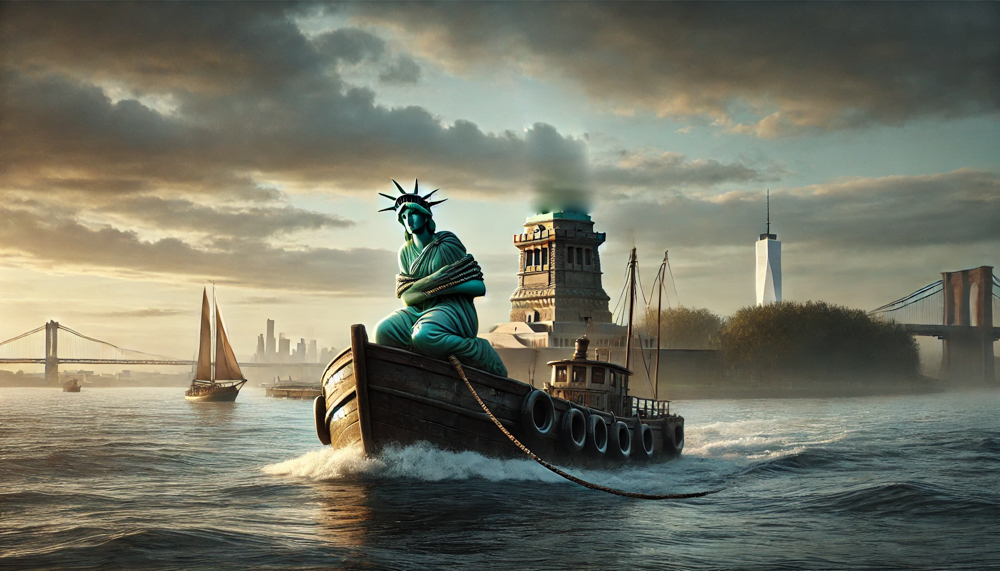
- The Economist sounded an alarm about the Trump administration engaging in Gunboat Capitalism.
- A headline by The New Republic reads: “Trump Is Running a ‘Global Mafia’.”
- Foreign Affairs writes about the dangerous consequences of Trump’s “assault on international law” in their article, “A World Without Rules.”
- The New York Times describes Trump as a president intoxicated by military spectacle and territorial acquisition, whose personal desires and sense of glory, rather than strategy, drive the dysfunctional and dangerous foreign policy of his administration.
- And finally, the Financial Times writes, “Trump is Making the World Fall in Love with China.”
How will this end?
In the 1939 movie The Wizard of Oz, the powerful Wicked Witch of the East wreaks unmitigated havoc on the Kingdom of Oz until Dorothy inadvertently splashes water on the cruel and vindictive witch. The Wicked Witch shrieks as she melts into a harmless pool of water. Donald Trump cannot survive a tsunami of truth and humanity that will eventually wash over him and his acolytes. Let’s hope this big wave of human decency sinks the Trump Gunboat sooner rather than later.