
Book Vibes > Fascism Rising in America: It Can Happen Here
In his analysis of how we have normalized extreme values that weaken liberal democracy, DiMaggio examines several preconditions for the rise of fascism in America.
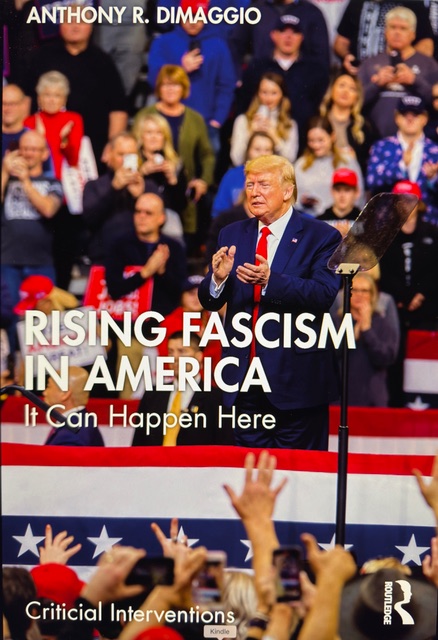
A timely review of DiMaggio, Anthony R. (2022). Rising Fascism in America: It Can Happen Here
By Wayne Stelk, PhD
August 26, 2025
In Brief
- DiMaggio’s 2021 warning about Trump’s fascist values in American politics is contrasted with Trump’s 2024 re-election and subsequent power consolidation
- Classical fascism has evolved into neofascism that works within democratic frameworks while systematically undermining them, using digital media and culture-war populism as primary tools
- Both right-wing media manipulation and liberal complacency (including neoliberal policies from Democratic leaders) contributed to democratic erosion
- Within the first six months of his presidency, Trump controls the executive and legislative branches with growing judicial influence, while resistance movements have proven largely ineffective
- Americans’ cultural obsession with commercialization and social media spectacles has left the public under-informed about increasing authoritarian threats
- Without an innovative “neodemocracy” adapted to the age of digitized information and artificial intelligence (AI), the rise of fascism threatens to become irreversible, endangering human dignity and democratic institutions
读书随感 > 美国法西斯主义的崛起:它可能发生在这里
简述 (In Brief)
- 历史的讽刺:安东尼·迪马吉奥 (Anthony DiMaggio) 在2021年曾对特朗普在美国政治中的法西斯价值观提出警告,这与特朗普2024年的连任及其随后的权力整合形成了鲜明对比。
- 新法西斯主义的演变:古典法西斯主义已演变为新法西斯主义。它在民主框架内运作,同时利用数字媒体和文化战民粹主义作为主要工具,对民主制度进行系统性的破坏。
- 双重成因:右翼媒体的操纵和自由派的自满(包括民主党领导人的新自由主义政策),共同导致了民主的侵蚀。
- 权力的巩固:在其总统任期的前六个月内,特朗普已掌控了行政和立法部门,且司法影响力日益增强,而抵抗运动却被证明收效甚微。
- 娱乐至死:美国人在文化上痴迷于商业化和社交媒体“景观” (spectacles),这使得公众对日益增长的威权主义威胁知之甚少。
- 新民主的呼唤:如果没有一种适应数字化信息和人工智能 (AI) 时代的创新型“新民主” (neodemocracy),法西斯主义的崛起恐将变得不可逆转,从而危及人类尊严和民主制度。
DiMaggio’s Warning: Spot-On or Exaggerated?
In December 2021, when political scientist Anthony DiMaggio released his book, the United States was seen as the world’s most stable democracy. Donald Trump’s attempt for a second term as president was rejected by most Americans. The January 6th attack on the Capitol by Trump loyalists, which Trump himself supported, did not succeed in keeping him in office. And as DiMaggio issued his dire warning, Trump was dealing with multiple civil lawsuits and criminal charges for alleged crimes that were paused during his presidency.
With a collective sigh of relief, the liberal left waved “goodbye” to the MAGA (Make America Great Again) movement. America was on the road to rebuilding democratic institutions that were damaged but not destroyed. And all was good.
Or was it?
With many liberal Americans feeling a guarded optimism, DiMaggio issued his warning about fascism rising in America. Four years later, was his warning justified?
President Donald Trump 1.0: A Budding Fascist?
DiMaggio does not label the first-term Trump as a mini-Mussolini or a spitting image of Hitler. His perspective adopts a broader and deeper view of fascist values and beliefs. He warned that fascist values and political strategies existed long before Trump, but had become “normalized” through various circumstances that went unnoticed by the American public.
Trump’s incitement of violence to undermine the 2020 election reflected the crisis of growing authoritarianism in America and a society increasingly infested with fascistic politics and ideology…(E)lements of fascistic politics in America have steadily become more extreme over recent decades, especially in the years under Trump’s presidency. (pg. 2)
In his analysis of how we have normalized extreme values that weaken liberal democracy, DiMaggio examines several preconditions for the rise of fascism in America. He is careful to note that the U.S., in 2021, had not become a fully fascist state like 1940s Germany or Italy. However, in today’s world, with Trump’s re-election in 2024 and his efforts to control all historic checks and balances, we can see that DiMaggio’s warnings have been prophetic.
With his 2021 predictions being realized in the news headlines of 2025, it is worth examining DiMaggio’s preconditions for the rise of fascism and the weakening of liberal democracy.
These preconditions for fascism include:
- The “normalization” of fascist values and political strategies by certain scholars, journalists, and even the Democratic Party.
- The increased influence of right-wing media pundits and outlets, such as Fox News, Infowars, Alex Jones (before being sued for his Sandy Hook conspiracy theories), and Joe Rogan, as America’s authoritarian values influencers.
- And surprisingly, Barack Obama and Bill Clinton’s support for neoliberal economic policies inadvertently pushed conservative Republicans further right
By citing these normalizing preconditions, DiMaggio points to both conservatives and liberals as responsible for the rising tide of fascist mindsets.
Fascism Evolves into Neofascism
The fascism that prospered in 20th-century Europe finds different conditions for growth in 21st-century America. As times change, so do political movements. The classical fascism of yesterday has emerged as the neofascism of today. How do the old and new compare?
After World War I, Mussolini and Hitler rose from modest beginnings to become influential strongmen, leading Italy and Germany to assert their sovereignty as a response to national humiliations. Both depended on loyal militias to eliminate their perceived enemies and establish their complete authority.
The hallmarks of classical fascism include political authoritarianism, anti-intellectualism, normalizing conspiracy thinking, glorification of state agents who control domestic “vermin,” encouraging white supremacy, and militarized nationalism. In short, fascist leaders established governments that eliminated opposing forces and exerted strongman leadership, relying on violence against perceived enemies.
As a rebirthed movement, neofascism promotes a fascist playbook adapted for democracies in the digital age. Instead of outright rejecting democracy, neofascist movements stay ultranationalist but operate within constitutional frameworks while gradually undermining democratic norms.
Influencers who support authoritarian values possess a sophisticated understanding of social media algorithms, utilizing platforms such as Facebook, Twitter, YouTube, and Telegram for the dissemination of propaganda and transnational coordination.
“Fascistic leaders” promote cultural rather than racial superiority, focusing on “Western civilization” and “Christian values” while portraying citizens as hapless victims threatened by globalization and immigration.
DiMaggio writes in 2021 about the rising neofascist influence in the United States. By 2025, it will become evident that rising neofascism is not just an American issue. In Europe, specifically Greece, Hungary, and Italy, the movement openly embraces Nazi symbolism, engages in street violence, and maintains militia-like organizational structures while exploiting refugee crisis fears.
Populism: Sleight-of-Hand Political Illusions
DiMaggio’s warning about America’s vulnerability to authoritarianism reflects a global surge in neofascism. In many countries, neofascist ideals are concealed by authoritarian leaders who pose as populists. I term this illusion as sleight-of-hand politics when self-interested, illiberal autocrats pretend to champion “oppressed citizens” suffering at the hands of evil elite forces.
In the U.S., authoritarians use propaganda and conspiracy theories to accuse liberal institutions of being dark forces controlled by the deep state.
By portraying themselves as noble fighters against the liberal elites of the dark state, authoritarians create the myth that they are protecting ordinary citizens from the evils of the dark state. At the same time, they implement policies that dismantle social safety nets, impose their bigoted worldview on the public, and cut taxes that benefit the wealthy.
For example, Donald Trump is declaring national emergencies to justify executive orders that restrict civil rights. His masked federal agents arrest people of color, without warrants and due process, and send them to punitive immigration detention centers. While the public is distracted by immigration and other spectacles, he pressures Congress to pass laws that further enrich the billionaire class.
Behind the illusory cover of “Dear Leader” populism, the neofascist leaders of today are “Robin Hoods” in reverse – pilfering the poor to give to the wealthy.
Liberal Complicity in the Rise of Fascism
DiMaggio lays some of the blame for these authoritarian perils at the feet of liberal intellectuals, including two former U.S. Presidents.
The ranks of the guilty liberals include scholars, journalists, and the Democratic Party, which promoted neoliberal policies that downplayed or misunderstood Donald Trump’s populist charade.
DiMaggio cites four reasons for the failure of “liberal” societal institutions to curb the rise of rightwing extremism:
- In the spirit of fair play, so-called liberal universities promoted balanced debate on political issues. This liberal ethic discouraged academics from engaging critically in the classroom or through scholarship that criticized the rise of right-wing extremism.
- Liberal media capitulated to the public’s political apathy. Americans’ cultural obsession with massive commercialization narrowed voters’ attention to spectacle and lifestyle, distracted them from extremist politics, leaving the public under-informed and unalarmed about increasing authoritarian rhetoric.
- DiMaggio criticized former U.S. presidents Bill Clinton and Barack Obama, as well as Hillary Clinton, for promoting neoliberal policies that resulted in rising income inequality, stagnating wages, and longer work hours. These liberal leaders also endorsed the rise of the gig economy, outsourcing, and corporate downsizing in an increasingly globalized economy.
- Public intellectuals, journalists, Democratic officials, and academics failed to fully recognize and call out neofascistic threats to the rule of law and democratic norms. Too often, liberals didn’t take Trump’s fascist rhetoric seriously.
But why didn’t these leading liberal voices recognize the dangers of America leaning toward authoritarianism? It is worth taking a moment to diverge from DiMaggio’s critique to understand that, for decades, liberals believed in the inevitability of liberalism as the ultimate goal for all governments worldwide. Considering the progress in civil rights and human welfare since the 1960s, many thought leaders assumed that traditional conservative values would be replaced by a future of liberal idealism.
In 1992, Francis Fukuyama famously prophesied the inevitable ascendancy of Western liberal democracy in his book, The End of History and the Last Man. Twenty-five years later, other authors, such as Timothy Snyder, took a more sobering look at the dangers to liberal democracies posed by international actors, such as Vladimir Putin in Russia. You can read my review of this “false hope” as critiqued in Snyder’s book, The Road to Unfreedom: Russia, Europe, America.
DiMaggio correctly pointed out how liberal contributions helped normalize fascist values in American society. However, his criticisms should be understood in the context of the widespread liberal faith in democracy’s ability to prevail against all odds. Believing this false hope, liberals thought they could ignore or play fair with MAGA conservatives and still succeed. As DiMaggio clearly shows, this reckless dream has transformed into a MAGA nightmare.
President Donald Trump 2.0: De Facto Fascist?
Labelling political movements (fascism, neofascism, populism, neoliberalism, conservatism, authoritarianism) is like counting angels on the head of a pin. Multiple labels overlap, making the exercise pointless for all but the most dedicated political scientists.
Additionally, assigning political labels to people is often pointless because it sparks arguments over the labels themselves and overlooks the values those labels represent.
Labeling the Trump 2.0 administration as fascist or neofascist only ignites heated and polarized debates. I suggest a more effective approach is to focus on describing the actions taken by Trump and his administration, rather than trying to pin a label on Trump 2.0.
Anyone who follows what remains of objective news reporting can see that, four years after DiMaggio’s warning about rising fascism in America, Trump has taken control over all powers and institutions in the federal government for the purpose of destroying American democracy.
It is beyond the scope of this book review to cite evidence of this destruction, but recall DiMaggio’s definition of a neofascist:
“Neofascist” refers to individuals, media organizations, and groups that openly espouse extremist politics in line with white supremacist-white nationalism, misogyny, hate, the romanticization of violence, support for paramilitarism, rightwing conspiracy theories fueled by a cultist commitment to a central leader, and attacks on multi-party governance. (p. 2)
Labeling Donald Trump as a “neofascist” only worsens partisan attacks. What matters is the values behind the label, and how the Trump 2.0 administration is actively and widely carrying out these values.
Through Mafia-like intimidation and coercion, Trump and his MAGA elites are succeeding in silencing dissenting voices. And perhaps even more concerning, many public voices are becoming accustomed to Trump’s policies. Americans are growing tired of protesting, and social media influencers are becoming more skilled at distracting the public with clickbait spectacles. Trump will soon face no restrictions in implementing policies with cruel effects on minority populations. Additionally, the normalization of his egregious actions will worsen as artificial intelligence (AI) generates virtual realities.
The Final Analysis: What Comes Next?
DiMaggio concludes his book by analyzing the role of liberal resistance movements, including Black Lives Matter (BLM), the #MeToo movement, and Antifa (anti-fascist) activism. Although organized resistance has arisen in opposition to Trump 2.0 policies that remove people’s human rights and dignity, Trump’s success so far indicates that liberal resistance has been mostly ineffective.
In just six months since his inauguration, Donald Trump now controls the reins of two of the three branches of the federal government (executive and legislative). He is steadily increasing his influence over the judicial branch. By the end of his term in 2028, he will control not only the federal government but also a significant portion of American culture and, by extension, multiple state governments.
What is also important about Trump’s attempt to impose a neofascist government on America is that his policies are crafted by a cabal of extreme right-wing politicians and ideologues who developed authoritarian playbooks, such as Project 2025. Considering rumors of Trump’s ill health, these ideologues will attempt to influence whoever succeeds Trump, should he leave office before the end of his term. It is this cabal that wants to see the complete and irreversible destruction of American democracy.
If liberal democracy is to have any chance of resurgence in the next decade, it will have to be resurrected as a “neodemocracy” that can adapt to a digitized world of virtual realities and AI-generated influencers.
In an increasingly globalized world, a new form of democracy must take root in smaller, more livable communities that transcend parasocial relationships on social media and prioritize interpersonal dialogue over partisan divides. Through respectful dialogue, communities can engage in debate over public policy differences without attacking each other’s values and identities. In future posts, I will explore an emerging interest in deliberative democracies.
Without an innovative and resurgent democracy, DiMaggio’s warning of fascism’s rising will become a death knell for human dignity and an equitable quality of life.
About the Author
Anthony R. DiMaggio is Associate Professor of Political Science at Lehigh University. His research emphasizes the interactions between politics, social movements, the news media, and the American right. He is the author of nine books, including Political Power in America (2019), Rebellion in America (Routledge 2020), and Unequal America (Routledge 2021).
Follow Me
In addition to Book Vibes reviews, I post thought-provoking essays in two series: Dancing at the Edge of Chaos and Dispatches from America, Inc. You can find all posts at Unpuzzling.me.